
What it's really like to work at BRANDTHINK Malaysia
If you are researching what it is like to work at BRANDTHINK Malaysia, you are probably trying to work out something our careers page cannot answer for you.
Will I learn? Will I get meaningful exposure? Will I enjoy the people? Will the work be too demanding? Will I be heard when I disagree? Those are fair questions.
BRANDTHINK can be a demanding place to work. We have high standards. We challenge work. We expect people to think, take ownership and become better at what they do.
That creates opportunities. People can work across very different industries and problems. They can be involved from an early idea all the way through to execution. When you see more, you also do more and learn more quickly. That’s the bargain.
For the right person, that can be exciting. It can also create pressure. We don't think one cancels out the other. A workplace can offer genuine growth and still have things it needs to improve.
Here are some questions we often get at interviews:
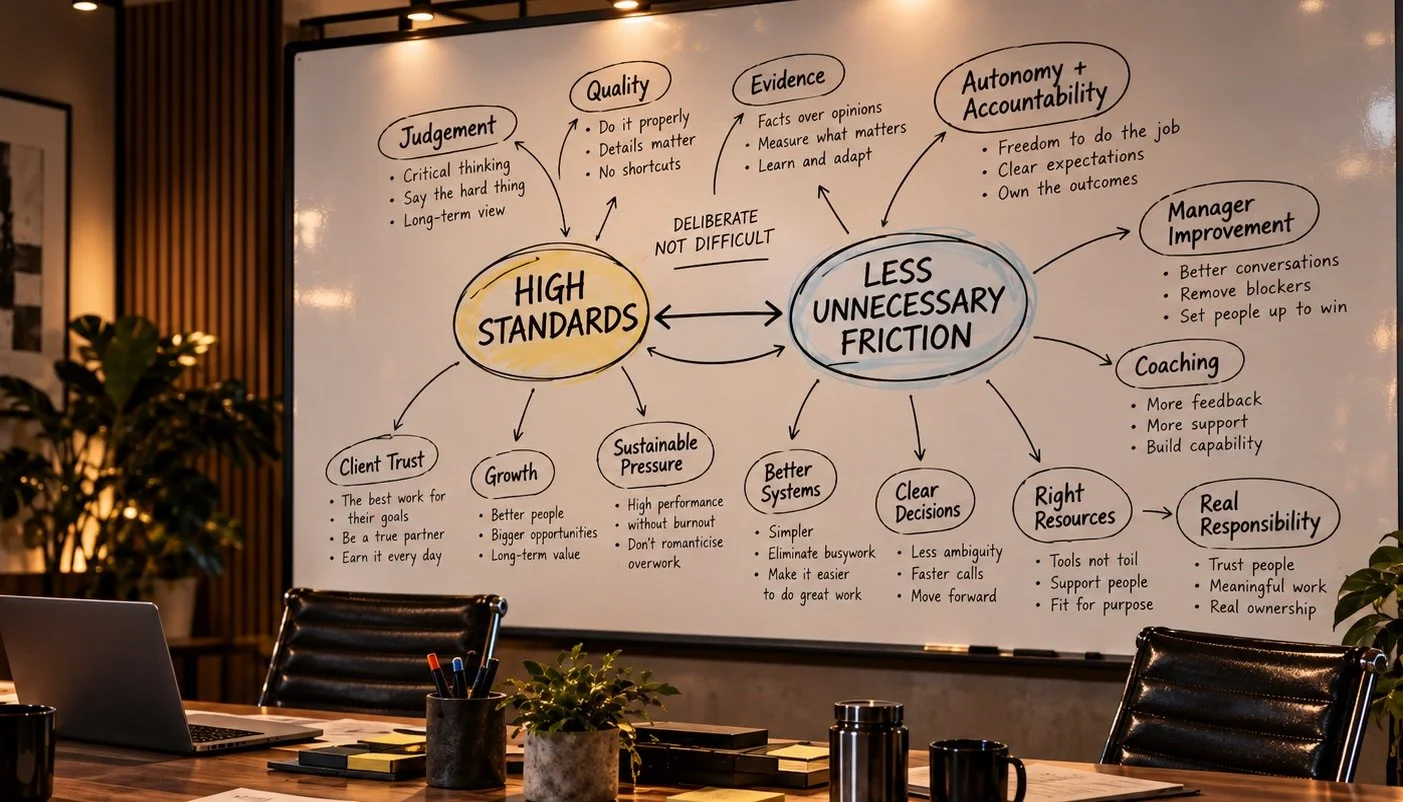
1 Are the standards at BRANDTHINK high?
Yes.
We want strong judgement and strong work. Completing a task is rarely enough if the thinking behind it is weak.
A strategy may be challenged. A design someone has spent hours on may need to change. A piece of content may be rejected. Someone may be asked why they made a decision rather than simply being told what to change.
Sometimes the feedback is simply: this isn't good enough yet.. We know that can be frustrating.
We could reduce some of that friction by accepting more things as good enough. We could stop pushing once something looks passable. Challenge fewer decisions. Accept more first drafts. Succumb to voices about how it is unnecessarily cumbersome. That would probably make certain days easier.
Our clients trust us with their brands, budgets and reputations, and a decision that feels small inside an agency can have much bigger consequences once it reaches the market. So we don't think easing off would make us a better agency.
The harder ambition is to keep raising the standard while reducing the unnecessary effort required to reach it. High standards will sometimes create pressure. Bad planning, unclear decisions and avoidable rework create a different kind of pressure. We want to become better at telling the difference.
2 Is BRANDTHINK a fast-paced workplace?
It is.
Agency work does not arrive in neat, predictable units. A client can change direction. Something that was approved suddenly isn't. Things move. One decision creates consequences for several other teams.
That is part of the work.
But "fast-paced" should not become a flattering phrase we use to excuse chaos. When everything is urgent, something is wrong. When people repeatedly work unreasonable hours, something deserves investigation. We don't regard overtime as a badge of honour. The useful question is why it is happening.
Maybe there is genuinely too much work. Maybe the client changed something late. Maybe the brief weren't clear. Maybe too much work had to be redone because the earlier work wasn't strong enough. Maybe somebody is taking much longer than the job should reasonably require.
At the end of a long work day, all of these can feel like the same problem: too much work, not enough time. They aren't the same problem. So they shouldn't automatically have the same solution.
3. Why doesn't BRANDTHINK just hire more people?
Sometimes we should. Sometimes we do. Sometimes it’s a full-time hire. Sometimes it’s external panel of gig workers.
If a capable team simply has more work than it can reasonably handle, then capacity is the problem. We can redistribute work, bring in external support or hire, definitely.
But increasing headcount before understanding the problem can make things worse. Every additional person creates another layer of complexity. If the root problem is something else, adding people may simply create a bigger system with the same problem. And if we made the wrong decision and hired the wrong person to join the team, that problem doesn’t get solved, it becomes compounded.
So when somebody tells us they are overloaded, our responsibility is to look underneath. What is actually on their plate? What would reasonably be expected from somebody at that level?
Sometimes the answer is that the employee needs more support. Other times the company needs to change something. Sometimes, a team member needs to improve.
4. We prefer evidence
People can look at the same situation and reach very different conclusions. That happens in every workplace. Our preference is to come back to what actually happened.
If somebody says an instruction was unclear, let's look at what was actually communicated: the brief, the email, the message, or the change of direction that followed. If we believe a deadline was reasonable, we should be able to explain why. If workload is the concern, look at the actual work.
Evidence does not mean there will never be disagreement. It gives us a better basis for resolving one.
And it has to work both ways. If the evidence shows we made the wrong call, we should be prepared to change it. We should be able to disagree. Disagreeing with a decision is not automatically being negative, difficult or disloyal. Sometimes one party is right. Sometimes they are not. Sometimes each side can see something the other cannot.
We won't pretend we always get this right. Managers can become frustrated. Tone can be wrong. A conversation can be handled better. When that happens, it is our responsibility to improve.
Listening doesn't mean we have to agree with every concern. It means the person raising the issue should be able to expect the argument to be considered on its merits. Accepting the conclusions when it doesn’t go their way is the hard part.
5. What is feedback like at BRANDTHINK?
Direct.
We don't believe useful feedback becomes better when it is wrapped in so much diplomacy that nobody knows what needs changing.
The work gets challenged. That is different from challenging the worth of the person who made it.
When several people on a project need to understand the same feedback, we often prefer the relevant project team to hear it together. Otherwise, one conversation can travel through several people and arrive at the other end as several slightly different versions of what was actually decided.
This works well for people who'd rather hear "this isn't there yet" than sit through several minutes of cushioning before getting to the same point. It doesn't work for everyone. If a challenged piece of work reads as a judgement on you personally, or you need warmth attached to every correction before you can hear it, the directness here will be hard going. Some people find that adjustment worth making. Others find out fairly quickly that it isn't for them, and that's a reasonable thing to discover early rather than a year in.
6. Are our managers perfect?
No.
There would be very little point writing an article about what it is really like to work here and then pretending otherwise.
Our managers need to keep getting better at coaching and developing people. They also need to get better at some of the mechanics of management. Planning earlier. Following through. Prioritising more clearly. Making decisions at the right time. Recognising problems before they become emergencies. They know it. That’s why they are also responsible for their own growth, just like all of us.
And as part of owning that, we put more effort into developing our managers. We are changing processes, improve access to information and help people make decisions faster.
7. Does BRANDTHINK micromanage people?
No. But sometimes, yes.
Micromanaging costs us time and work we rather use elsewhere, so we'd rather someone gained independence quickly than have someone checking in on every step.
There are two moments where that changes. The first is when we're introducing a new process or way of working. We want people following the new approach rather than falling back into old habits, so we'll stay closer until it sticks.
The second is underperformance, specifically when somebody doesn't seem to recognise it or isn't doing anything to change it. That's when stepping back stops being trust and starts being neglect.
Outside those two situations, we rather be spending time playing pickleball.
8. Experience should show up in judgement
We don't expect everyone to work at the same speed. Someone who has spent 8 years doing a job should have advantages that someone doing it for five months hasn't yet had time to develop. Experience creates pattern recognition.
For us, the two clearest places are judgement and quality. A more senior person should normally recognise the important problem sooner, make better calls, produce stronger work and need less fundamental correction. Those things usually improve speed anyway, because fewer wrong turns need to be corrected.
People at every level will make mistakes. The bigger question is what happens afterwards. Does the feedback change the next piece of work? Does the person understand why something needed to change? Does the same problem keep returning?
The more senior the position, the more we expect learning to compound. Experience should make someone increasingly useful.
Being senior here isn't just a title for time served. It comes with more to carry: catching problems in someone else's work before a client sees them, coaching someone through a mistake instead of just fixing it for them, owning an outcome even when the call behind it was yours. That's what our appraisal system is built to measure.
That's harder to see than a checklist, which is exactly why appraisal can feel unclear, or like it favours whoever's most visible. A checklist is easy to trust because anyone can hold it up to anyone's work. Judgement isn't as visible from outside the room.
9. Autonomy comes with accountability
We like independent people. We want somebody who can look at a problem, think about it and move, without needing somebody more senior standing nearby supplying the next instruction.
But autonomy comes with accountability. If you want freedom over how you organise your time, you also have to be reliable about what that time produces. If you want authority to make decisions, you carry responsibility for those decisions. Nobody gets to approve their own work simply because they spent a lot of effort producing it.
That's not a technicality. A decision made here rarely stays here, it can land on a client's business, a colleague picking up the next piece of work, or the agency's name with people who never sat in the room. How much you get to decide alone isn't something you're owed. It has to match what's actually at stake.
Trust develops the same way. People and teams that consistently demonstrate good judgement, strong work and reliable delivery naturally earn more of it, and more trust usually creates more autonomy.
From the outside, different levels of trust can sometimes look like different treatment. Which is why the difference needs a reason behind it. Fairness doesn't always require identical treatment. It does require that the difference be defensible.
10. What should people get from working at BRANDTHINK?
Challenge on its own is not much of an employee proposition. The opportunity lies in what comes with it.
People here get clear expectations, professional treatment, fair compensation, reasonable systems and a genuine effort to keep workloads sustainable. They also get exposure to different industries and different kinds of problems, the chance to work across disciplines, and to be involved from early thinking through to execution rather than handing work away and never seeing what happens to it.
For someone who is curious, proactive and wants to get considerably better at what they do, that can be valuable.
11. What does this mean for our clients?
Ideally, confidence.
Our clients should not have to care about most of our internal debates. They hire BRANDTHINK because they expect judgement and work they can trust, and they shouldn't have to absorb the cost of our growing pains.
If our planning creates unnecessary pressure, we need to improve the planning. If somebody isn't ready for a responsibility, we need to develop them or change the responsibility. If a process creates needless delay, we should fix the process. If capacity really is the problem, we should increase it.
The client should experience the benefit of our standards, not the friction involved in maintaining them.
That is one reason we can be demanding inside the company. A weak recommendation can send a client's money in the wrong direction. Get a careless detail wrong and it can cost real reputation. A bad judgement call wastes time nobody gets back.
The work eventually leaves the building. So do the consequences.
12. Is BRANDTHINK Malaysia a good place to work?
It depends on what you are looking for.
If you care deeply about the work itself, you already have something in common with us. If you want exposure to different industries, want to understand how ideas become execution and want to get better at what you do, there is a lot here to learn.
If you want autonomy and are equally willing to carry accountability, you will probably understand the culture fairly quickly. If you are comfortable having your thinking challenged, and equally comfortable challenging ours with evidence, even better.
If you prefer an environment where every task is clearly handed down, every next step is supplied and criticism is rare, BRANDTHINK may frustrate you. That doesn't automatically make you wrong, and it doesn't automatically make us right. People want different things from work, and what matters is being clear about the bargain.
We are demanding. We are imperfect. We are still learning how to make demanding work happen better.
There is one trade we remain reluctant to make. We don't want to reduce unnecessary pressure by reducing ambition. We would rather remove the things that make good work harder than it needs to be.
Sometimes that means better management. Sometimes better systems. Sometimes more resources. Sometimes somebody, at any level of the organisation, needs to get better.
The difficult part is being honest enough to work out which one it is. That is the standard we want to hold ourselves to as well.
This November, BRANDTHINK turns 26.
In that time we have grown, got things wrong, rebuilt teams, lost clients, won new ones and heard just about every reason why something couldn't be done. Not much surprises us anymore.
One thing we have worked hard to protect is our teams from the commercial anxiety of running an agency. Revenue, margins, payroll, keeping clients and winning the next piece of business are leadership problems. The people doing the work should be able to spend most of their energy on the work itself, and on getting better at it.
That doesn't mean the work will always be easy. It means we want the pressure they feel to come from trying to do something well, rather than worrying about where the next client is coming from.
If we can keep giving people that space while holding the bar high, we will have done our job.