
How to evaluate a PR agency when you don't work in PR
You don't need PR expertise to tell whether an agency is good at it. You need to follow their reasoning, and know which questions a media list can't answer for you.
You have been asked to find a PR agency. You don't work in PR.
Now you're sitting through presentations about media relationships, journalist networks, coverage, influencers, events, awards and impressive client logos, trying to work out which agency is actually good.
Some of that matters. It just doesn't answer the most important question: can this agency understand what your business needs PR to do, work out who needs to be influenced, find a credible reason for people to care, and explain how you'll know whether any of it worked?
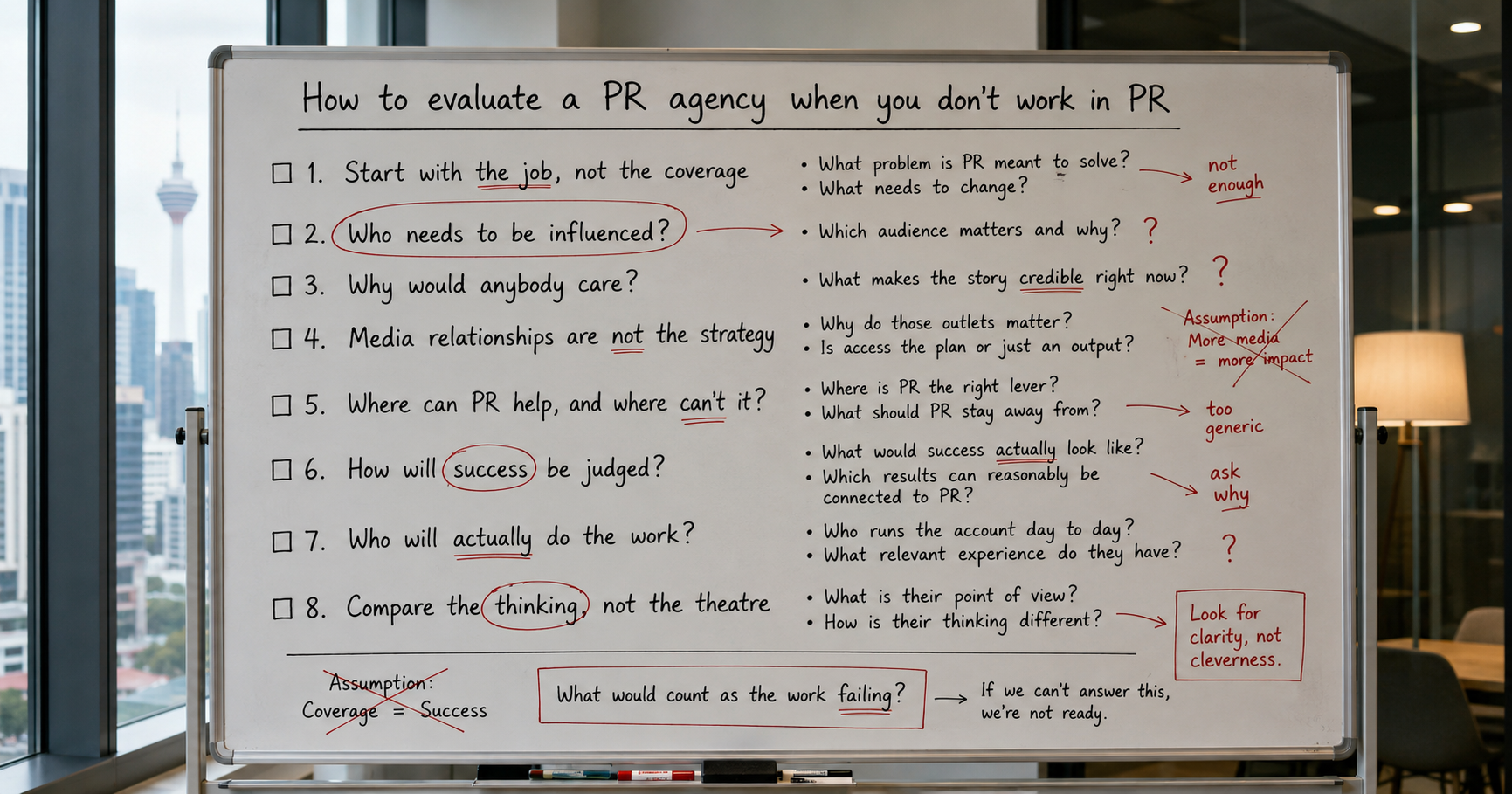
Start with the job, not the coverage
Before comparing agencies, get clear on what you're actually hiring PR to accomplish. "Get us media coverage" is an activity. It doesn't tell you why the coverage matters.
A company launching into a new market may need credibility. A brand entering a crowded category may need to become easier to understand. A business facing criticism may need to rebuild trust with a specific group of people. Those are different jobs, and they require different stories, audiences and ways of measuring whether the work did anything useful.
So one of the first things to watch during a pitch is whether the agency tries to understand the problem before prescribing the PR. If they move straight from your brief to a list of media targets, ask them to go back a step. What do they think PR actually needs to change? Their answer will tell you a lot.
Ask who actually needs to be influenced
"The media" is usually not a sufficient answer. Journalists, editors and creators may be important routes to attention. But the real question is who ultimately needs to know something, believe something, or do something differently. That could be potential customers, an industry audience whose opinion lends credibility, or another group entirely.
A useful agency should be able to tell you which audience matters and why, then tell you what that audience currently believes, what would make them pay attention, and what they'd find credible coming from your company. You don't need them to arrive at the pitch already knowing everything. Sometimes the honest answer is that more information is needed. What you're looking for is whether they think in terms of influence, rather than a spreadsheet of publications.
Why anybody should care about the story
This is where a lot of PR plans become more revealing. A company has something it wants to announce. That doesn't automatically make it interesting to anybody outside the company.
We learned how easy this is to get wrong on a real project. The brief was to write a stronger version of one planned announcement. The actual problem had nothing to do with the writing. An earlier announcement had already used up the most obvious story, so the real question became what this next moment could credibly say that hadn't already been said. Checked against what the audience had already heard, half of the usual "what makes an opening newsworthy" checklist turned out to be beside the point.
That's the trap worth watching for in a pitch: an agency can give you a technically correct answer to "why is this newsworthy" that's still wrong, because it's answering the category's version of the question instead of your specific one.
So push past the generic version. Why is this a story, for this audience, right now, given what they've already heard? Sometimes the honest answer is that the story isn't strong enough yet. Perhaps it needs evidence. Perhaps the spokesperson needs a sharper point of view. Perhaps there's a customer story buried inside the announcement that nobody has surfaced. An agency willing to tell you that before taking your budget is giving you judgement instead of a sales pitch.
Media relationships matter. They are not the strategy.
You'll probably hear about media relationships during a pitch. You should.
Knowing journalists, editors and how different outlets work is part of the craft. But a long media list can create a false sense of security. A relationship helps an agency know when to pitch and when to leave a journalist alone. It cannot turn a weak story into a strong one indefinitely.
So when an agency tells you about its network, go one step further. Why do those particular outlets matter to your problem? Who do they actually reach that you need to influence? What would the agency do if the original story didn't earn interest? Access is useful. Knowing what deserves to be put through that access is more useful.
See whether they know when PR can help, and when it can't
A PR agency obviously believes in PR. That doesn't mean PR is the answer to every problem.
If customers can't find the product, more coverage won't fix that. If the experience is poor, positive stories may just create expectations the business can't meet. If the issue is mainly commercial, operational or product-related, communications may have a supporting role rather than the leading one.
A strong agency recognises those boundaries. Ask where PR sits in the wider plan, what needs to happen before PR can work, and which parts of the problem sit outside the agency's control. Be wary of a plan where every road conveniently leads back to more PR activity.
Ask how they'll judge the work before the work starts
PR reporting can produce impressive-looking numbers: coverage volume, potential reach, impressions, mentions, share of voice. Some of that is useful. None of it should be allowed to answer a question it can't answer.
Ten pieces of coverage tell you that ten pieces of coverage appeared. They don't, by themselves, tell you whether the right people noticed, believed the message, or did anything differently afterwards.
So ask about measurement during the pitch, not three months into the retainer. What would success actually look like? Which results can reasonably be connected to PR, and which can't? The exact measures depend on the job. What matters is whether the agency can explain the chain between what it will do and what you're trying to change. That should be decided before the work starts, not worked out afterwards to justify the invoice.
Be especially cautious when an agency jumps straight from media coverage to a large business claim. PR can contribute to business results. A press clipping didn't cause them on its own.
Find out who will actually do the work
The people in the pitch matter. So do the people who turn up after it.
Ask who will run the account day to day, who develops the story, who speaks to the media, and how involved the senior people stay once the retainer starts. There's no single correct agency structure. A smaller senior team can work brilliantly. A larger specialist team can make sense for a complex brief. What you need is clarity on what you're actually buying. If the strongest people disappear from the relationship the moment the pitch ends, that changes the value of everything they promised in it.
Compare the thinking, not the theatre
At the end of a pitch process, you may have several agencies with good credentials. Their decks will contain recognisable clients. Their work will probably all look competent.
Go back to the decisions they made, not the polish. Which agency understood the problem most clearly, and which one just repeated your brief back at you in better formatting? Which one had a specific, credible reason for people to care, rather than a generic one that would fit any client in the category? And which one could tell you honestly what would count as the work failing, not just succeeding?
That last question matters more than it sounds like it should. PR deals with people, timing, news and reputation, none of which any agency fully controls. You're not hiring somebody for a guarantee that everything goes to plan. You're hiring them for what they do when it doesn't.
A good PR agency should make the decision easier
You don't need to become a PR expert before you appoint one. You need to be able to follow the agency's reasoning.
They should be able to explain the problem they believe they're solving, the people who matter, the story those people might care about, where earned attention can help, and what evidence would tell you whether the work did its job.
The media list can come after that. So can the credentials deck. If the thinking holds, those things help prove the agency can execute it. If the thinking doesn't hold, a longer media list won't fix it.