
What do high standards actually look like inside an agency?
A client asks for a campaign. The team thinks a campaign will not solve the problem. Weeks have gone into a strategy. Then new information lands and the recommendation no longer holds. A launch is approaching and somebody spots a serious flaw in the idea everyone has already agreed to.
By that point, protecting the work already done can feel easier than telling the client we need to change course. These are the moments that tell you what an agency's culture is actually made of. At BRANDTHINK, we talk a lot about standards. Craft and detail are part of it, but the harder test is judgement.
What do you do when the answer is uncomfortable, the decision has consequences and your name is attached to what happens next?
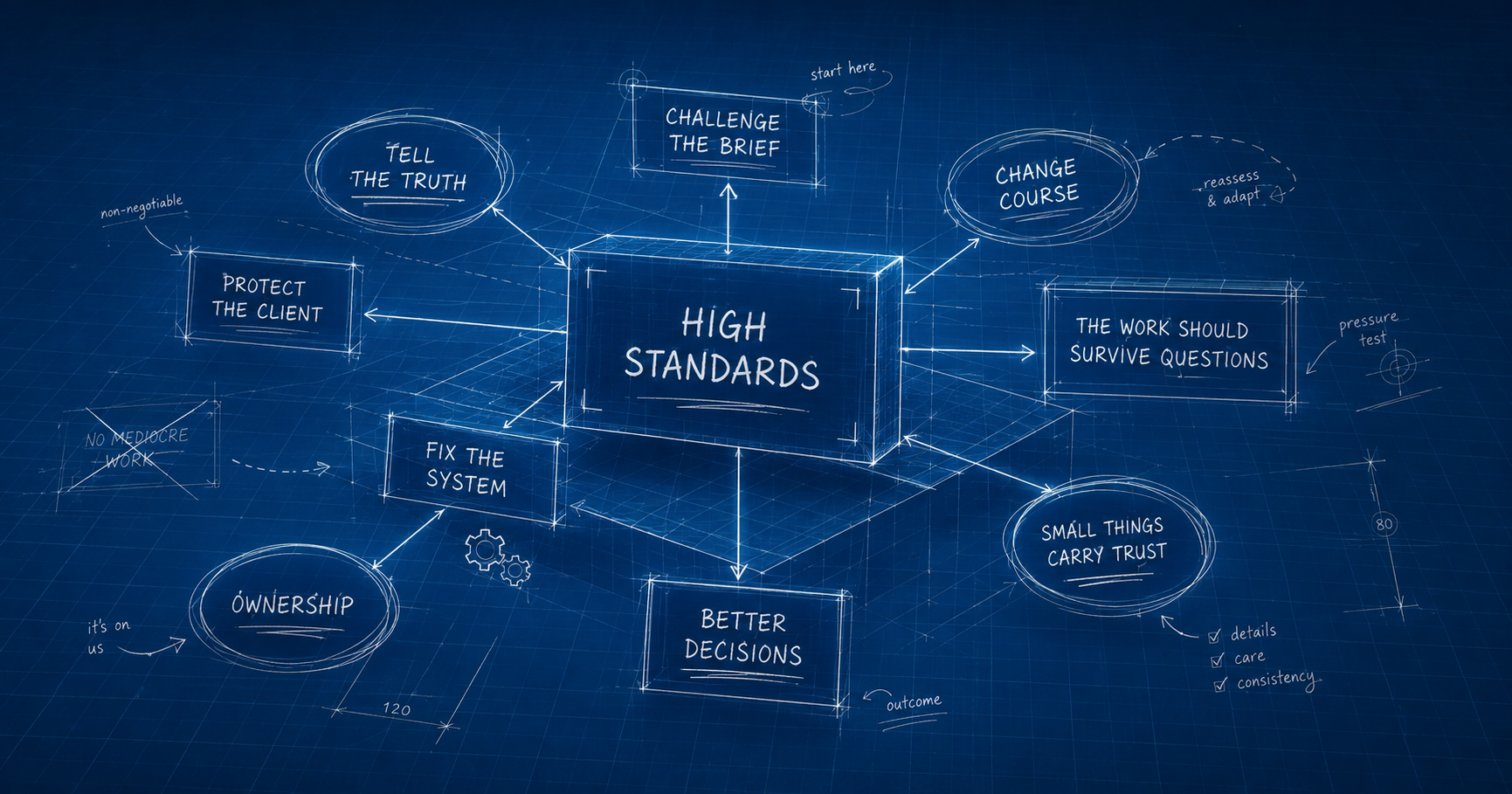
When the brief and the problem are not the same thing
Clients hire agencies to do things. Build a campaign. Launch a product. Create a social strategy. Get people talking. Produce an event. Our job includes doing those things well. It also includes asking whether the thing we have been asked to make is going to solve the problem in front of us.
Sometimes the brief has got it right. We should respect that and get on with the work. Sometimes something does not add up. High standards mean somebody has to notice.
That does not give an agency permission to challenge every brief for sport. There is no intelligence in manufacturing disagreement just to look strategic. The judgement is knowing when something genuinely needs challenging and having a reason strong enough to do it. Because once we recommend a direction, the client is going to put time, money and reputation behind it. We should be able to explain why.
When weeks of work are pointing in the wrong direction
This one hurts. A team has spent weeks researching a problem. There have been workshops, late conversations, presentations and rounds of development. People have started to believe in the answer.
Then somebody finds the thing that does not fit. Maybe the evidence points somewhere else. Maybe the strategy sounds convincing but does not actually change what we should do. Or the creative idea is good and the strategic argument underneath it is weak. At that point, all the effort already spent can become surprisingly persuasive.
It shouldn't.
If the recommendation is wrong, another week polishing it will not make it right. Someone has to be willing to say we need to go back. That gets harder when the work is yours. Harder when the room likes it. Harder again when the deadline is close. But protecting three weeks of work at the expense of the next six months of a client's marketing is a very expensive form of pride. We would rather lose the work we have already done than defend something we no longer believe deserves to go forward.
When the client's money is attached to the idea
Agency presentations can make ideas feel strangely weightless. A launch mechanic becomes a slide. A film becomes a storyboard. An activation becomes a beautifully rendered visual. An influencer programme becomes a list of names and projected reach.
Then somebody has to pay for all of it.
Clients trust agencies with real budgets, real reputations and decisions that can affect what their businesses do next. So an idea being exciting is not enough. We need to know what job it is doing. Why this audience? Why this channel? Why this level of investment? What are we asking people to do differently? What would make us decide the money should be spent somewhere else?
Marketing does not always give us perfect evidence. There still needs to be a reasoned decision. If we cannot explain why a piece of work deserves the client's money, we have a bigger problem than the creative.
When something important goes wrong
Things go wrong in agencies.
A recommendation misses something. Production runs into trouble. A launch does not unfold as expected. Someone makes a call that turns out to be the wrong one. At that point, making the situation look better is less useful than understanding what happened, what the client needs from us now and what we are going to do about it.
Ownership gets talked about a lot in companies because it sounds good. It gets harder when the mistake is yours. Can you raise the problem before somebody else discovers it? Can you say, "That was my call"? Can a junior person tell a senior person that something has been missed? Can the team start fixing the situation before disappearing into an argument about whose fault it was?
There should be accountability. Serious mistakes need serious examination. But making people frightened to surface a problem only means we find out later. We would rather know while there is still something we can do.
When the person you disagree with outranks you
Seniority matters. Experience matters. Neither guarantees the right answer.
If a strategist thinks the recommendation is flawed, they should be able to say so. If an account executive can see that the client has been promised something the team cannot deliver properly, that matters. The same is true when a designer sees an execution undermining the idea. The conversation should not end because the most senior person in the room already approved it.
That does not mean every decision becomes a referendum. Someone still has to make the call. But we want the work to survive questions. Why are we doing this? What evidence are we using? What happens if this assumption is wrong? Are we still defending the best decision, or simply the one we made first?
People need to learn how to challenge well. They also need to learn how to be challenged without treating disagreement as disrespect. That takes practice.
When pressure stops being exceptional
Agency work gets intense. There are launches that cannot move. Pitches with hard deadlines. Live events where the problem has to be solved now. Some periods are going to ask more from people than others.
We've hit this pattern often enough ourselves to be wary of it. Resilience can become a lazy answer. If every project requires heroics, the problem may be the way the work is being run. If the same emergency keeps happening, eventually we need to stop congratulating ourselves for surviving it and fix whatever keeps creating it.
That could mean better planning. A harder conversation about scope. More realistic timelines. Saying no to work we cannot do properly. Changing the process. Changing the decision.
Sometimes it means admitting that the company needs to do better. And sometimes the right thing is simply to stop. People need time to recover. A worn-down team does not make sharper decisions. It makes tired ones, then tries to defend them as considered thinking. Recovery is part of protecting the quality of the work.
High standards place demands on people. They also place demands on the organisation creating the conditions in which those people work. We have not always got that balance right. We are still learning.
People are allowed to be unfinished
A high-standard culture can become a pretty miserable place if nobody is allowed to learn. A junior strategist's first deck will not read like their fifth. A designer moving into a new discipline will make choices a more experienced person would have caught. Someone running a client relationship for the first time will probably handle a difficult conversation differently after they have done it ten more times.
That is part of getting better. The thing to watch is whether the work is moving.
Did you understand what went wrong? Did the feedback change anything? Are you asking better questions the next time around? Are you repeating the same mistake because you are still learning, or because nothing changed after the last conversation?
There is a difference.
We are not interested in punishing people for being early in their development. We are interested in whether they are developing. Nobody arrives finished. What matters is whether the work, the judgement and the person are getting better.
And yes, the small things still matter
None of this makes the ordinary work beneath us.
The wrong number in a deck matters. A sloppy handover matters. A sentence that says something the client did not mean matters. Sending work nobody properly checked matters.
Small things carry trust.
They also tell you something about how a person approaches the bigger work. Pay attention. Understand what your work affects. Think beyond the instruction. Take responsibility for what leaves your hands. Someone can make a strong strategic call and still damage trust through careless execution. Someone else can execute every small task perfectly but never question whether the team is making the right decision.
The work needs judgement and craft.
The point is to become better at making decisions
There should be a consequence to spending years working here. You should become better at spotting the real problem.
Better at knowing which argument matters and which one merely sounds clever. Better at telling a client something they may not want to hear without turning honesty into theatre. Better at knowing when to fight for an idea and when to let it die. Better at taking responsibility when your judgement turns out to be wrong. And eventually, somebody else should become better because they worked with you.
That is the standard we are trying to build at BRANDTHINK. The work should get better.
So should we.