
More like a Sports Team than a “Family”
"We're like a family here." Well, not really.
We understand why companies say it. It's supposed to mean people care about one another, help each other and build relationships that go beyond the transaction of work.
We want those things too. It's the family part we're less comfortable with.
Families come with obligations. You help because they're family. You stay because they're family. You forgive things because they're family. Saying no can feel selfish. Disagreement can feel like disloyalty. Leaving can feel like betrayal.
We would rather think about BRANDTHINK as a high-performance team.
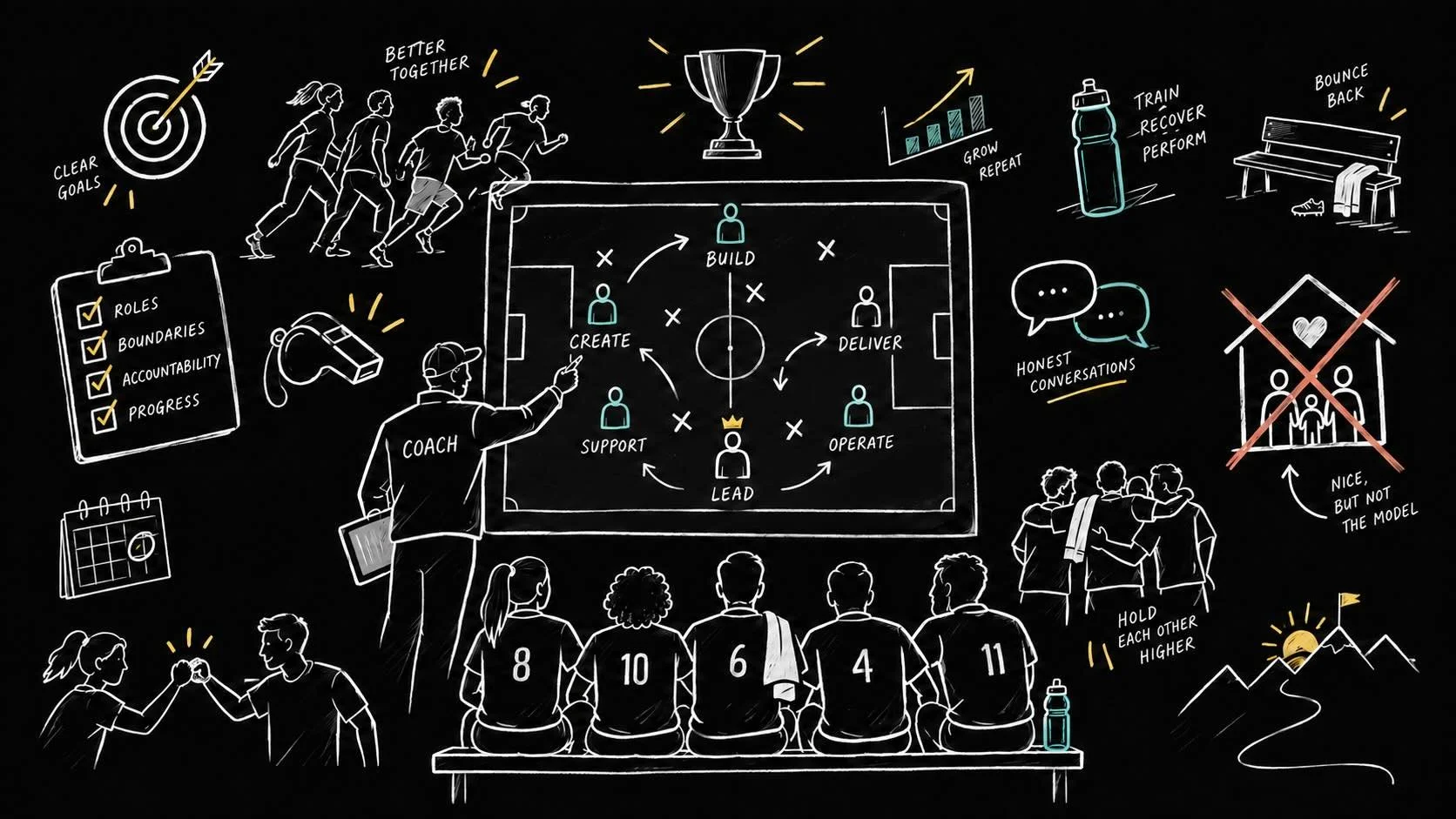
People can still be close. They can care about each other and have each other's backs when things get difficult.
But there are clearer boundaries. You have a role. Other people depend on you doing it well. There are standards. There is coaching. Everyone carries responsibility. Including the coach.
Work needs boundaries
We don't want somebody staying late out of guilt, disagreeing with us to feel like disloyalty, or leaving one day to feel like betrayal. People owe the company professionalism, judgement and the effort they agreed to give. The company owes people clarity, fair treatment and the conditions to do good work.
Colleagues can still become lifelong friends. That still doesn't make the company a family.
A team has a job to do
A good sports team can be incredibly close, training, losing, arguing and celebrating together. But nobody is confused about why the team exists. There's something it's trying to achieve, and everyone has a role in achieving it.
That's closer to how we think about our agency. Strategy, PR, content, design, brand and activation require different strengths. Some roles are more visible at particular moments. Some spend more time supporting everyone else's work.
Fairness doesn't mean everybody does the same thing. It means people understand what's expected of them and what the team needs from them.
Training happens before match day
No serious sports team expects players to improve simply by playing more matches. They train. They practise what they're bad at, repeat boring things and review mistakes, building capability before they need it under pressure.
Work should be the same. Development can't just mean handing somebody more projects and hoping experience does the rest. People need feedback, coaching and somewhere to practise.
That's also the thinking behind our Athletic Dept. and things like pickleball, a preventative way to build the habits and relationships that get tested later by a difficult client, a tight deadline or conflict inside a team.
Feedback should make someone better
Nobody joins a serious team expecting the coach to stay silent when something needs to improve. If the work isn't good enough, we should say so, and help the person understand what better looks like. Then responsibility shifts back to them. Did anything actually change?
Experience should show up the same way: a senior person sees problems earlier, makes better decisions and helps the people around them perform better. At some point, your contribution can't be measured only by your own output.
Talent doesn't give anyone a free pass
Sports teams sometimes face an awkward problem: the brilliant player who makes the team worse. Companies have versions of that too, someone commercially valuable, creatively brilliant or technically excellent, who still makes everyone around them less effective.
If colleagues constantly have to compensate for you, repair relationships around you or clean up problems you create, your output doesn't tell the whole story. A high-performance culture can't mean the highest performers are exempt from it.
The coach is accountable too
This is where companies abuse the sports analogy: "high performance" becomes another way of telling people to work harder. But if a team keeps losing, eventually you look at the coaching. Was the team prepared? Were the tactics wrong? Did the coach make a bad call?
Management has the same responsibility. Repeatedly working unnecessary hours because planning is poor isn't a commitment problem. Reworking things because decisions were unclear isn't solved by telling people to be more efficient.
Planning, priorities, decisions and resources are management responsibilities too. Accountability has to travel upwards.
Rest is part of performance
Athletes don't train 24 hours a day. Recovery is part of performance, not proof of how exhausted you are, it's what makes performing again possible.
That's also how we think about work-life balance. It's not about working as little as possible, we want ambitious people who care about what they do. But becoming better at work shouldn't mean becoming worse at living. Health, relationships and time away from work all feed back into good performance eventually.
Teams change
This may be the biggest difference between a company and a family. Families are supposed to stay families. Teams change.
People develop. Roles change. Somebody right for one stage may not be right for the next, or may want something we can't offer. Sometimes, despite real effort on both sides, it doesn't work, and that doesn't make either side bad.
A good company gives people a fair chance to succeed. But keeping somebody indefinitely in a role where they can't is not kindness, their colleagues carry the cost, and eventually clients do too.
We still want people to care
Rejecting the family metaphor doesn't mean building a colder company. We want people to know colleagues outside their department, build real friendships, celebrate together, argue properly and notice when somebody's struggling. We want people to take pride in belonging here.
We'd just rather those relationships were chosen than demanded through the language of family. Players can challenge the coach. The coach can challenge the players. People can leave without becoming enemies, and everyone has some responsibility for whether the team gets better.
We don't need BRANDTHINK to be a family. We'd rather build a team worth belonging to.